ESD workspace planning for PCB assembly and electronics testing
A productive electronics workspace brings the process, equipment, and people together. Plan ionizer placement and cable access around the boards and assemblies your team handles, from bench assembly to inspection and hardware testing.
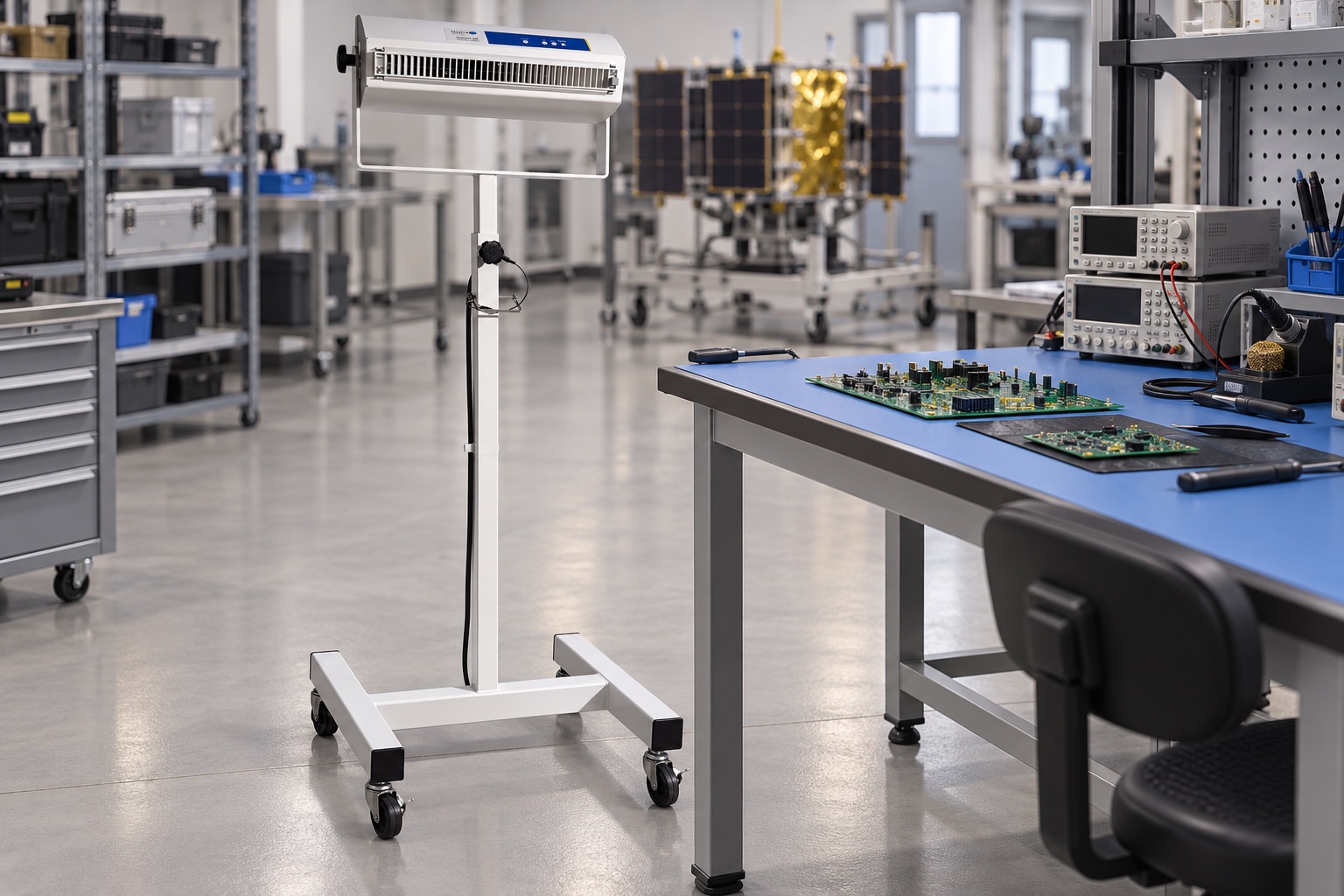
Understand the static-control challenges
Material contact and separation can generate static charge during electronics handling. Discharge can damage sensitive devices immediately or leave defects that appear later. Charged surfaces can also attract particles, making contamination another consideration in assembly and inspection.
Grounding and ionization serve different roles. Grounding provides a path for charge on suitable conductive items; ionization can help neutralize charge on necessary insulating materials. Choose controls around the actual process and verify them within your facility’s ESD program.
Plan around the application area
Review the points where operators handle boards, move fixtures, connect cables, or need access to sensitive hardware. Each area places different demands on the workspace.
- PCB assembly and rework benches: allow space for the assembly, tools, and the ionizer’s intended airflow path.
- Inspection and device testing: coordinate stand placement with microscopes, fixtures, test sockets, and operator access.
- Hardware integration and functional test: plan cable runs between the test cabinet, computer workstation, and hardware under test.
- Final assembly and packaging: review handling materials and movement between work areas as part of the ESD-control plan.
Standards and program requirements
ANSI/ESD S20.20 addresses the administrative and technical requirements of an ESD control program. IEC 61340-5-1 also sets requirements for establishing and maintaining a program to protect electronic devices from electrostatic phenomena.
IPC J-STD-001 addresses soldering processes and materials; IPC-A-610 addresses electronic assembly acceptability. These documents serve different purposes from an equipment specification. Use the editions and requirements identified by your customer and facility quality program.
Specify equipment against your documented requirements and confirm the installed configuration with your ESD coordinator. A stand or cable cover is one part of the workspace; selecting it does not establish compliance for the complete process.
Position an ionizer without crowding the bench
The DeSmet 102-101 mobile stand is designed for the Simco Aerostat® XC2. Its mount adjusts from 42 to 66 inches in 2-inch increments and rotates 360°. The 20 × 19 inch base and four conductive casters support flexible positioning beside a workstation.
Follow the ionizer manufacturer’s instructions for placement, airflow, operation, and maintenance. Check performance at the work location using your facility’s verification procedure. The stand provides mechanical support and positioning; the ionizer provides the ionization. For other blower models, send mounting details and weight for compatibility review.
Keep cable routes accessible
Cable Step Covers can follow a wall perimeter or protect a run between equipment and a workstation. Choose the fixed-top 103-100 for a fixed walking surface, or the opening-top 101-100 when cable inspection and routing changes require access beneath the cover.
Both standard covers measure 36 × 24 × 9.5 inches overall. Share bundle and connector dimensions to confirm usable clearance. Special ESD leveling feet are supplied for EPA applications, and non-ESD footing can also be supplied. Follow facility flooring and grounding requirements for the selected configuration.
Turn the workspace plan into an equipment request
Send a layout or sketch showing the bench, test equipment, operator positions, and cable route. DeSmet can review the standard products and application-specific options with your team.
- Ionizer model, mounting details, desired height, and available floor space
- Cable-bundle and connector sizes, access needs, and expected loading
- Flooring, grounding, caster or footing, cleaning, and material requirements
- Product quantities, required delivery date, and inspection documentation
Application and standards resources
Explore the application background and the standards publishers’ descriptions.
Specifications and datasheets
Explore each model and download the technical details for your quote request.
- Cable Step Cover, Fixed Top — 103-100
Download the 103-100 datasheet (PDF) - Cable Step Cover, Opening Top — 101-100
Download the 101-100 datasheet (PDF) - Ionizer Stand — 102-101
Download the 102-101 datasheet (PDF)
Simco-Ion’s XC2 blower information and manufacturer resources.
The DeSmet 102-101 stand is designed for use with the Simco-Ion Aerostat XC2. DeSmet Industries is not affiliated with or endorsed by Simco-Ion. Product names identify compatibility.
Request your quote
Send the workspace requirements above, along with quantities and your required delivery date.